
Unsymmetrical Bending
- Response within 1 business day
- Global logistics
- Tender-ready docs
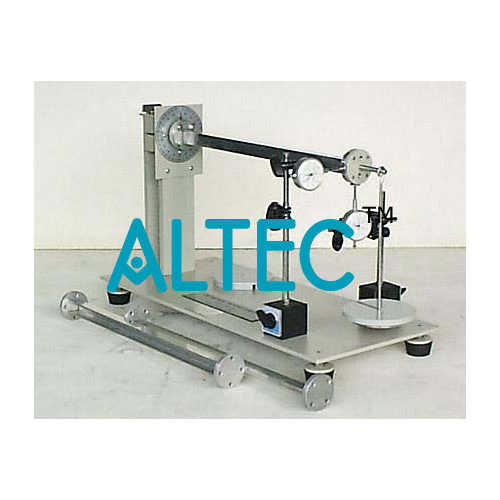
Symmetrical bending of a beam – also known as uniaxial bending - occurs when the load plane coincides with one of the main axes of the beam cross-section. The beam then deflects in the direction of the load and can be described by elastic lines. In unsymmetrical bending of a beam - also known as complex or biaxial bending - the main axes of the cross-section do not coincide with the direction of loading. To prevent torsion, the line of application of the load must pass through the shear centre. If it does not, the beam undergoes combined bending and torsion loading.This is used to perform experiments relating to symmetrical and unsymmetrical bending and to combined bending and torsion loading. The beam under investigation is clamped into place on one end and loaded down by a set of weights at the free end. Two dial gauges record the horizontal and vertical deformation of the beam. The unit includes three beams with different cross-sectional profiles: I, L and U. The beam can be clamped with freedom to rotate in any direction. This enables investigation of loading along the main axis or of the general load case. An angle scale at the clamping point indicates the angular position of the beam. It is possible to adjust the load application point eccentrically, so that purely unsymmetrical bending or combined bending and torsion loading is investigated. The various elements of the experiment are clearly laid-out and housed securely in a storage system. The well-structured instructional material sets out the fundamentals and provides a step-by-step guide through the experiments.
Specification:
1. Experimental unit for general and unsymmetrical bending of straight beams
2. 3 beams: I, L and U profiles
3. Clamping flange of beam can be clamped in the pillar free to rotate in any direction
4. Clamping flange with angle scale to indicate the angular position of the beam
5. Eccentricity of load application point adjustable
6. 2 dial gauges with bracket to record the horizontal and vertical deformation of the beam under load
7. Storage system to house the components
Technical Data:
Aluminium beam
- deformed length: 500mm
Eccentricity of load application point: 0…25mm
Dial gauges
- 0…10mm, graduations: 0,01mm
Angle scale
- 0…360°, graduations: 1°
Weights set
- 1x 2,5N (hanger)
- 1x 2,5N
- 3x 5N
Detailed technical specifications, datasheets and brochures available on request. Email sales@equipmentsexporters.com with your tender BoQ for itemwise specifications.
To request a quotation for Unsymmetrical Bending (Product Code ALABS-A104-245), share your tender BoQ or requirement list by:
- Email: sales@equipmentsexporters.com
- Phone: +91 9311469084
- WhatsApp: +91 9311469084
Quotation turnaround is typically 24-48 hours with brochures, datasheets and a priced compliance statement.